

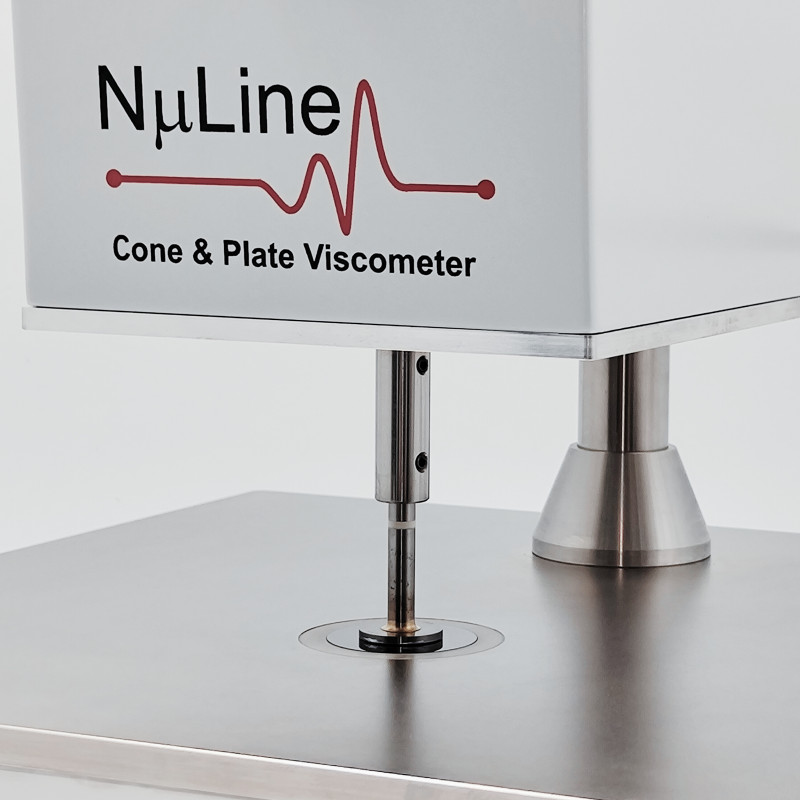
Cone and Plate viscometers are versatile machines, with similarities to rheometers, that enable very precise, accurate viscosity readings. But they are not the same as the less-accurate spindle viscometers. So how do they work?
In cone and plate viscometers the fluid is sheared between a shallow cone and a fixed, heated plate. This use of a cone allows for a constant shear rate across the width of the entire sample.
In simple terms – the shear rate is the linear velocity of the cone surface divided by the gap at that point.
The benefit of cone and plate viscometers over spindle viscometers is the fact that this uniform shear rate is applied across the entire sample. In spindle viscometers – fluid near the shaft moves faster than fluid at the edge, creating different shear rates. Cone and plate viscometers eliminate this inconsistency and provides absolute viscosity, not relative.
As the cone spins above the plate, the torque acts upon a coiled beryllium spring – the displacement of which is measured using a magnetic rotary encoder. This is what gives us our viscosity readings.
The flat, heated plate also allows for precise temperature control of your fluid, which ensures stable sample conditions – an essential factor for viscosity.

What is Shear Rate?
Some fluids behaviour can change when placed under stress. Shear rate is the speed at which a fluid is manipulated / deformed / altered by the stress being applied to it. For example, paint on a brush, oil in an engine, or tooth paste on a tooth brush.
Cone and plate viscometers allow for testing at different shear rates, enabling reproduction of real-world scenarios and how they affect fluids. Spindle viscometers cannot do this.
NuLine cone and plate viscometers are the perfect device for testing across a range of shear rates, to very high accuracy. We can supply two versions that cover two temperature ranges and what’s more- they are extremely reliable, well-made, and easy to use.